Termite Control & Treatment
Liquid barrier, bait system and spot treatments for subterranean termites, plus what a Georgia termite contract (bond) must spell out before you sign.
- Which Georgia license each job needs, and how to look it up
- Cost ranges cited to Angi, HomeGuide and Fixr, never invented
- Termite letter (WIIR) and termite bond rules in plain English
- Free to use, with no obligation and no markup
Fast response from independent local providers. No obligation.
Typical national cost$300 – $2,000Cost guide →About Termite Control & Treatment
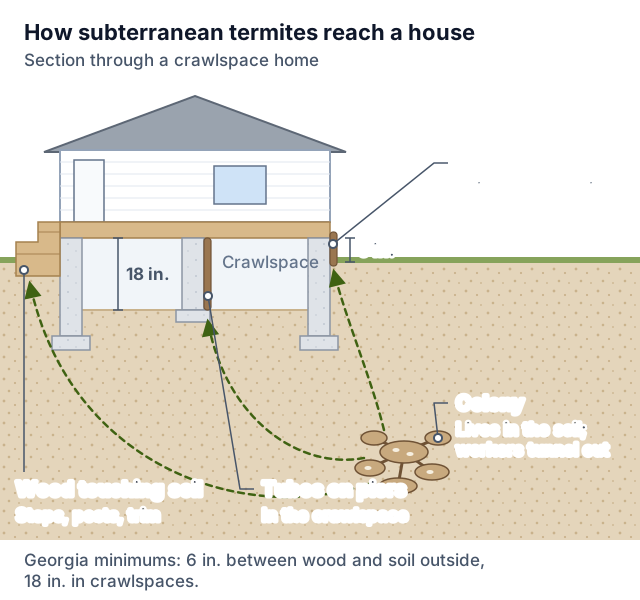
Subterranean termites are the termite problem in Georgia. UGA Extension notes they dominate the Southeast, with the eastern subterranean termite the most common species, and that Georgia swarms start in February and peak from March through May (UGA Extension B1241). Formosan termites have been found in Georgia since the early 1990s but remain rare (UGA Extension C868). In metro Atlanta, crawlspace homes, wood in contact with soil, and damp foundations can all give termites a way in, and a treatment decision is expensive enough to slow down for.
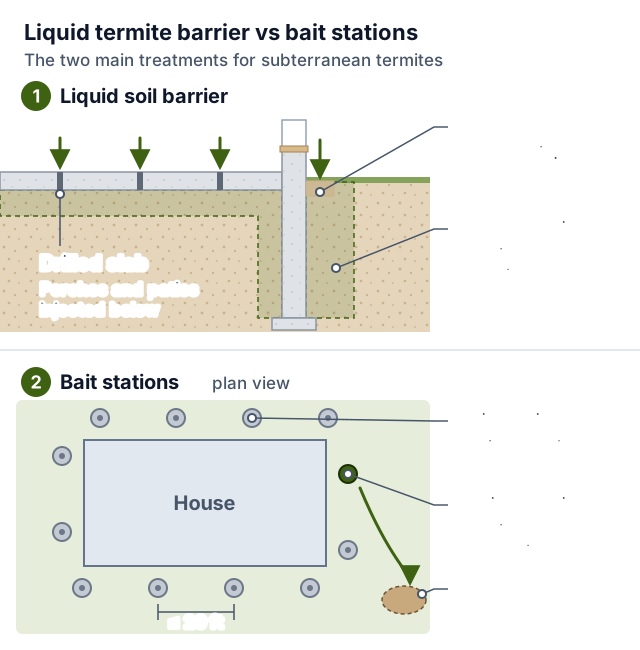
Treatment usually means one of three approaches. A liquid termiticide barrier is applied by trenching around the foundation and drilling slabs, porches and patios where needed. A bait system uses monitored stations around the house. A spot treatment targets activity in one limited area. Published figures put liquid treatment at about $3–$16 per linear foot, or about $300–$1,200 for a whole house in Georgia, and larger or harder homes can exceed $2,000 (Fixr Georgia; HomeGuide). Bait system installation runs about $1,000–$2,500 (HomeGuide; Today's Homeowner), plus about $200–$400 a year for annual monitoring or a plan (HomeGuide; Angi).
Georgia is specific about termite contracts. Under the Georgia Structural Pest Control Commission rules, the written contract, which most people call a termite bond, must state the treatment type, the effective date and term, a diagram of the structure, the price, and the renewal fee along with how many years it's fixed and how often the home is reinspected. It must also carry a boxed statement saying whether the warranty covers retreatment only, or retreatment and repair. You sign before work starts, the contract must disclose your 3-day right to cancel, and on a one- or two-unit home it can't limit the treated area.
Soil treatments have minimum standards too: debris removed, six inches of clearance between wood and soil outside and 18 inches in crawlspaces, mud tubes removed, a six-inch trench, and termiticide applied at the label rate. If a company can't meet a minimum, Georgia requires an Official Waiver signed by the owner, so read any waiver before you sign it. Bait contracts must carry a boxed warning that removing the bait system may leave the home unprotected, and the company must keep station-by-station monitoring records.
Termite work in Georgia falls under Category 30, Wood-Destroying Organism (WDO) control. Before you sign, look the company up on the Georgia Department of Agriculture's license search and ask whether its Designated Certified Operator holds the WDO category. Atlanta Pest Guide is a referral service, not a termite company. Requests go to independent local companies, which inspect, quote and warrant their own work.
Common Jobs We Route
- Liquid termiticide barrier treatment, with trenching plus drilling at slabs, porches and patios where needed
- Termite bait system installation and ongoing station monitoring
- Spot or localized treatment where activity is confined to one area
- Retreatment under an existing termite contract after new activity
- Taking over, renewing or transferring a termite bond when you buy a home
- Correcting conditions found at inspection: wood-to-soil contact, debris and moisture
What Affects the Price
Providers quote their own work — these are the factors that consistently move the number.
- Treatment method: a liquid barrier, a bait system and a spot treatment are priced very differently
- Linear feet of foundation, and how much drilling slabs, porches, patios and additions require
- Construction type (crawlspace, basement or slab) and how easy the crawlspace is to get into
- Warranty type: retreatment-only vs. retreatment-and-repair coverage, and the annual renewal fee
- Active infestation vs. preventive treatment, and whether wood repair or moisture correction is part of the job
How It Works
- Step 1
Leave the evidence alone
Don't break mud tubes, spray swarmers or vacuum them up. Photograph what you see and save a few insects in a sealed bag or jar.
- Step 2
Request an inspection
Your request goes to an independent local company that does termite work in your area.
- Step 3
Check the WDO license
Confirm the company on the Georgia Department of Agriculture license search and ask about its Category 30 (WDO) operator.
- Step 4
Read the contract before you sign
Method, diagram, the boxed warranty statement, the renewal fee, the reinspection schedule, and your 3-day right to cancel.
Free Termite Control & Treatment Tools
Get a realistic number or a quick diagnosis first — free, built on published industry data.
Compare your options
In an emergency?
Termite Control & Treatment FAQs
How much does termite treatment cost in Atlanta?
A liquid barrier typically costs about $3–$16 per linear foot, or about $300–$1,200 for a whole house in Georgia, and larger or harder homes can exceed $2,000 (Fixr Georgia; HomeGuide). Bait systems cost about $1,000–$2,500 to install, plus about $200–$400 a year for monitoring. A spot treatment is about $250–$1,000 (This Old House; Angi). Our termite treatment cost guide and calculator walk through the details.
What is a termite bond in Georgia?
It's the written termite contract between you and the company. Georgia rules require it to state the treatment type, term, a diagram, the price, the renewal fee and reinspection frequency, and a boxed statement saying whether it covers retreatment only or retreatment and repair. It's not the same thing as a company calling itself 'bonded', which refers to a surety bond. A company that advertises itself as bonded must actually hold one and disclose its coverage in writing.
Is a termite bond worth it?
It depends on the terms, not the label. Compare the renewal fee against what's covered: retreatment-only contracts don't pay for damage repair, while retreatment-and-repair contracts may, within limits. UGA Extension notes that many companies sell five-year contracts renewed annually, and suggests asking in writing for an annual inspection if one isn't included. If you're buying a home, ask whether the existing contract transfers and for what fee. Our termite bond checker walks through these questions.
Liquid treatment or a bait system: which is better?
Neither is right for every house. Liquid barriers treat the soil around the whole foundation at once. Bait systems rely on termites finding stations, which then have to be monitored over time. Ask each company why it's recommending its method for your house, what the contract covers if activity returns, and what the renewal costs, so you can compare like with like.
What happens if termites come back after treatment?
Your contract's warranty terms decide what the company owes you, which is why the boxed retreatment or repair statement matters. Georgia rules also require a complete retreatment when three or more separate active infestations are found within five years. If a company won't honor its contract, you can ask the Georgia Department of Agriculture to investigate through its Structural Pest Control Inspection Request form or by calling 404-656-3641.
Why would a company ask me to sign a waiver?
Georgia sets minimum standards for soil treatment, such as wood-to-soil clearance and debris removal. When a house can't meet one, for example where the required wood-to-soil clearance isn't possible, the company must get the owner's signature on an Official Waiver. Read it before you sign: it records exactly which minimum isn't being met.
Local Termite Control & Treatment Guides
Termite Control & Treatment by Area
Need termite control & treatment?
Send the short form — no obligation.