Termite Swarm in the House: What to Do Right Now
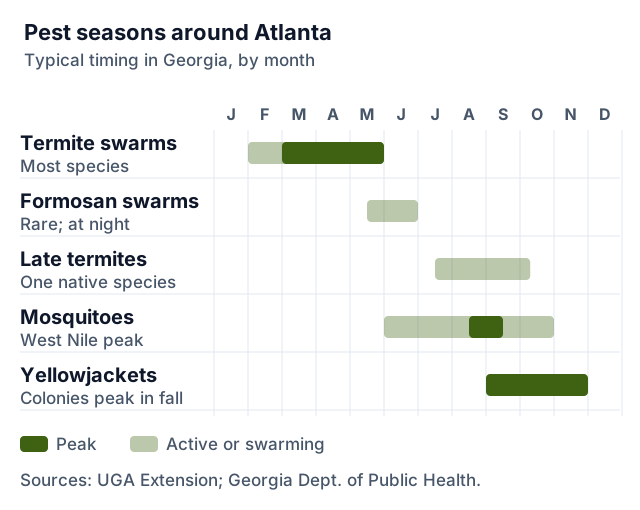
A cloud of small winged insects at a window or light, often followed by piles of shed wings, is the classic sign of a termite swarm. In Georgia, swarms start in February and peak from March through May (UGA Extension). One species swarms from late July into early October, and the rare Formosan termite swarms at night in late May and June.
Flying ants look similar, and a swarm isn't proof of termites until someone qualified inspects. The most useful thing you can do now is keep the evidence intact, save a sample, and book an inspection with a company licensed for termite work in Georgia.
If this is unsafe or getting worse right now, don't wait — send an emergency request and it's flagged for priority routing to an independent local pro.
What to do in the first 5 minutes
- Leave the swarmers, shed wings and any mud tubes where they are as far as you can. Don't spray, fog or vacuum them before the inspection.
- Save a few insects in a sealed bag or jar, or on clear tape, and photograph where they appeared (window, light fixture, bathroom, near a wall or crawlspace door).
- Note the date, time and spot so the inspector can look for where they came from.
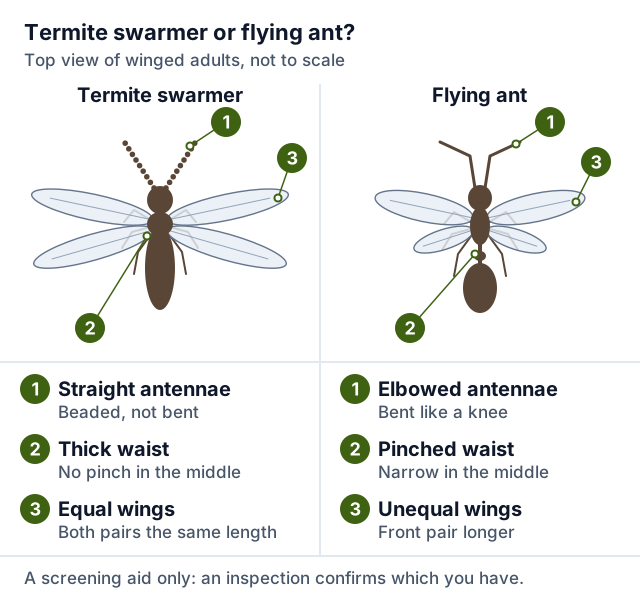
- Compare a sample against the termite-or-flying-ant checklist on this page. It's a screening aid, not a diagnosis.
- If you have a termite contract (bond), call that company first and ask what your warranty covers: retreatment only, or retreatment and repair.
- Otherwise, book an inspection with a company holding a Georgia Wood-Destroying Organism (Category 30) license. Check it on the Georgia Department of Agriculture's license search.
Do not do this
- Don't spray swarmers with a household bug spray or set off a fogger. Using any pesticide in a way that isn't consistent with its label violates federal law (EPA), and spraying removes the evidence an inspector needs.
- Don't break open mud tubes or pull apart wood to look for termites. Leave the evidence for the inspector, and have any damage evaluated by a building-trade inspector, as Georgia's termite report form advises.
- Don't sign a termite contract on the spot. Georgia rules require a written contract that states the treatment, the warranty in a boxed statement and the renewal fee, signed before work starts, with a 3-day right to cancel disclosed (Georgia Structural Pest Control Commission rules).
- Don't hire anyone for termite work without checking the license. Termite treatment for hire in Georgia needs a structural pest control company with a Category 30 certified operator.
Common causes
Eastern subterranean termites (most common)
Subterranean termites dominate the Southeast, and the eastern subterranean termite is the most common species (UGA Extension). Their swarms usually start in February and peak March through May, and indoor swarms often mean a colony is nearby, in or under the structure.
Flying ants
Winged ants swarm too, and they're the most common lookalike. The usual screening traits: termite swarmers tend to have straight antennae, a thick waist and two pairs of similar-length wings, while ants have elbowed antennae, a pinched waist and unequal wings. Only an inspection confirms which you have.
A late-summer subterranean species
One native subterranean termite (Reticulitermes hageni) swarms from late July to early October in Georgia (UGA Extension), so a swarm outside spring doesn't rule out termites.
Formosan subterranean termites (rare)
Formosan termites have been found in Georgia since the early 1990s but are rare, and are often spread by railroad crossties. They swarm at night from late May to June (UGA Extension C868).
Diagnose it now
What it typically costs
A termite inspection typically costs about $75 to $250, and many companies inspect free when it isn't for a sale. If treatment is needed, a liquid barrier on a Georgia home typically costs about $300 to $1,200 (Fixr), and larger or harder homes can exceed $2,000. Spot treatments typically run $250 to $1,000. See the termite treatment cost guide for bait systems and bond renewals.
Frequently Asked Questions
Does a termite swarm inside mean my house is infested?
It's a strong reason to get an inspection, but not a diagnosis. Swarmers coming out indoors often point to a colony in or under the structure, while flying ants can look nearly identical. A licensed inspector can confirm the insect and look for mud tubes and damage.
Should I spray or vacuum the swarmers?
No, not before the inspection. Leave them, save a sample in a sealed bag or jar, and take photos. Spraying a product off-label violates federal law (EPA), and cleaning up removes the evidence the inspector uses to find the source.
When do termites swarm in Georgia?
Most swarms start in February and peak from March through May (UGA Extension). One native species swarms from late July to early October, and Formosan termites swarm at night in late May and June.
Who can inspect for termites in Georgia?
A structural pest control company with a Wood-Destroying Organism (Category 30) certified operator. A WDO-certified or registered technician can do the inspection. Look the company up on the Georgia Department of Agriculture's license search.
Will my termite bond cover a swarm?
Check the boxed warranty statement in your contract: Georgia rules require it to say 'retreatment only' or 'retreatment and repair'. Call the company that holds your contract first, since it is usually responsible for retreating covered activity.
The service that handles this
Guidance only — independent local providers assess and price their own work. Last reviewed 2026-10.
Sources for the cost figures
- UGA Extension B1241: Termite Control Services, Information for the Georgia Property Owner
- UGA Extension B1209: Biology of Subterranean Termites in the Eastern United States
- UGA Extension C868: Identifying the Formosan Subterranean Termite
- Rules of the Georgia Structural Pest Control Commission (effective April 8, 2026)
- EPA: Introduction to Pesticide Labels
- Georgia Dept. of Agriculture: Structural Pest Control license search
- Fixr: Termite Treatment Cost in Georgia (Jan 31, 2025) (third-party estimate)
Prefer to just talk to someone?
Send the short form — we'll route you to an independent local pro.