Termite Inspection & Termite Letters
Termite inspections for peace of mind or a sale, and the Official Georgia Wood Infestation Inspection Report (the termite letter) often requested at closing.
- Which Georgia license each job needs, and how to look it up
- Cost ranges cited to Angi, HomeGuide and Fixr, never invented
- Termite letter (WIIR) and termite bond rules in plain English
- Free to use, with no obligation and no markup
Fast response from independent local providers. No obligation.
Typical national cost$300 – $2,000Cost guide →About Termite Inspection & Termite Letters
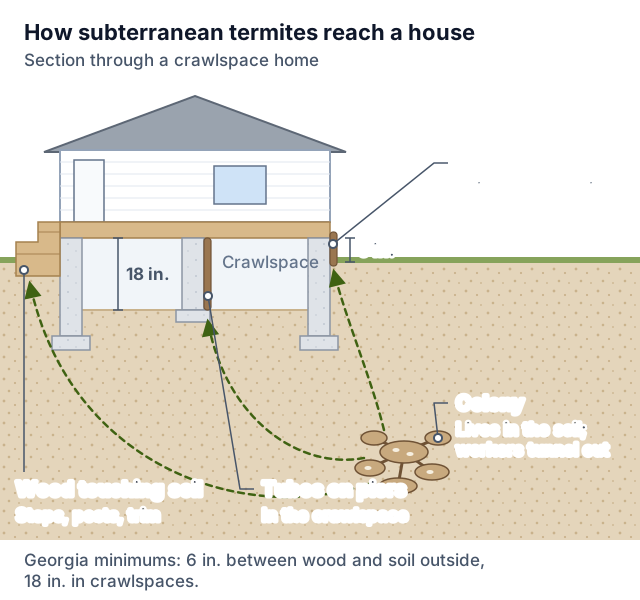
A termite inspection is a visual check of the accessible parts of a home: the foundation, the crawlspace or basement, the garage, the attic where it can be reached, and exterior wood. The inspector looks for termites, damage and the conditions that invite them, such as wood touching soil and moisture. Many companies inspect for free when a treatment sale may follow. A standalone inspection typically runs about $75–$250 (Fixr Georgia; Angi Atlanta). Inspections tied to a home sale are different, because Georgia has an official form for them.
In Georgia, the 'termite letter' is the Official Georgia Wood Infestation Inspection Report, or WIIR. Under the Georgia Structural Pest Control Commission rules, it's the official document certifying that a structure is apparently free of wood-destroying organisms, as a basis for transferring the property. The Georgia Department of Agriculture's WIIR fact sheet says it's the only form accepted for Georgia transfers, and the national NPMA form isn't. Buyers and lenders often request one at closing, but the rules themselves don't say it's required, so ask your agent or lender what your contract calls for.
Only a company with a WDO-certified operator may issue a WIIR. A WDO-certified or WDO-registered technician may carry out the inspection, but the company's WDO Designated Certified Operator signs the report. Typical fees are about $100–$200 (Fixr Georgia; Angi), though some companies charge more.
The WIIR comes with a guarantee that can't be altered. If an infestation is found within 90 days of the report's issue date, the issuing company must treat it free. Conducive conditions that existed at the time of inspection but weren't reported must also be corrected free within 90 days. Keep the report, and note its issue date, with your closing papers.
A termite letter is not a structural report and not a warranty that termites are absent. It covers only five wood-destroying organisms and only readily accessible areas, and it excludes mold. It must disclose any past treatments by the issuing company, any current contract and its expiration date, whether the warranty transfers to a buyer and at what fee, any Official Waiver, and areas that were obstructed or inaccessible. If the report notes damage, have a building-trade inspector or contractor evaluate it. The Georgia Department of Agriculture may inspect the work within two years of a WIIR's issue.
Atlanta Pest Guide routes inspection and termite-letter requests to independent local companies; we don't inspect homes or issue reports. Before booking, look the company up on the Georgia Department of Agriculture's license search and ask whether its operator holds Category 30 (WDO).
Common Jobs We Route
- Official Georgia Wood Infestation Inspection Reports (termite letters) for home sales and closings
- Pre-purchase termite inspections for buyers
- Pre-listing inspections so sellers can deal with findings before the house goes on the market
- Annual reinspections under an existing termite contract
- Inspections after a swarm, mud tubes or suspected wood damage
- Second-opinion inspections before signing a treatment contract
What Affects the Price
Providers quote their own work — these are the factors that consistently move the number.
- Purpose: a free sales inspection, a standalone inspection, or an official termite letter for a closing
- Home size, crawlspace access, and how many additions, decks or outbuildings need to be included
- How soon the report is needed before a closing date
- Whether the company already holds a contract on the home, since reinspections are often part of the renewal
- Findings: activity or conducive conditions can turn an inspection into a treatment or repair quote
How It Works
- Step 1
Tell us the purpose
Peace of mind, a suspected problem, or a termite letter for a sale. Include the closing date if there is one.
- Step 2
We route your request
It goes to an independent local company that does termite inspections in your area.
- Step 3
Confirm the WDO credential
Look up the company and ask whether its operator holds Category 30 (WDO). Only WDO-certified companies can issue a WIIR.
- Step 4
Read the report
Check the issue date, inaccessible areas, past treatments, contract and transfer details, and any waiver.
Free Termite Inspection & Termite Letters Tools
Get a realistic number or a quick diagnosis first — free, built on published industry data.
Termite or Flying Ant? Swarmer Identification Check
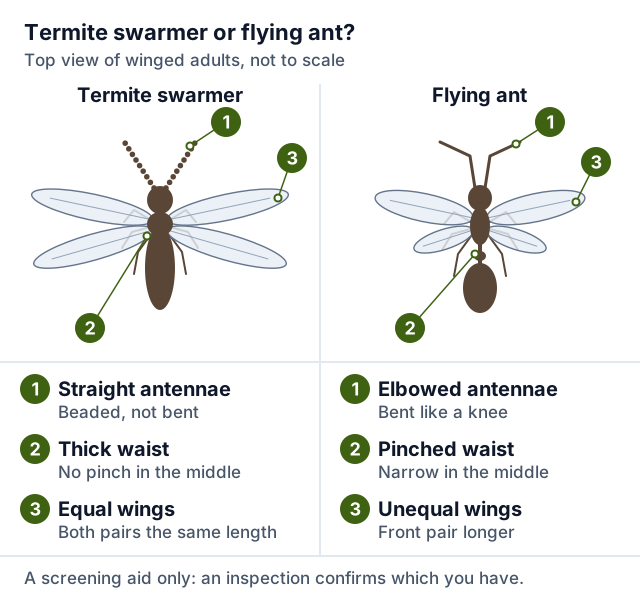
Found winged insects inside? Compare antennae, wings and waist, plus where and when they swarmed, to see whether they look more like termites or flying ants.
Use the free tool →Termite Bond Checker: Is My Termite Bond Worth It?
Answer questions about your termite contract to see what it covers, whether it meets Georgia's contract rules, and what to do if it doesn't.
Use the free tool →Compare your options
Termite Inspection & Termite Letters FAQs
What is a termite letter in Georgia?
It's the Official Georgia Wood Infestation Inspection Report (WIIR): the official document certifying a structure is apparently free of wood-destroying organisms, as a basis for transferring property. The Georgia Department of Agriculture says it's the only form accepted for Georgia transfers. It's not a structural report or a warranty that termites are absent, and it covers only readily accessible areas.
Who can issue a Georgia termite letter?
Only a company with a WDO-certified operator. A WDO-certified or WDO-registered technician can do the inspection, but the company's WDO Designated Certified Operator signs it. You can check the company on the Georgia Department of Agriculture's structural pest control license search.
Do I need a termite letter to close on a house in Georgia?
It's often requested at closing, by buyers or by lenders, but the Georgia rules describe it only as a basis for transferring property, not as a requirement. Check your purchase contract and ask your agent or lender. If one is needed, order it early enough that any findings can be dealt with before closing.
How much does a termite letter cost in Georgia?
Typically about $100–$200 (Fixr Georgia; Angi), though some companies charge more. A general termite inspection that isn't for a sale typically runs about $75–$250, and many companies offer it free. See our termite inspection and termite letter cost guide for the details.
What does the 90-day guarantee on a termite letter cover?
If an infestation is found within 90 days of the report's issue date, the issuing company must treat it free. Conducive conditions that existed at inspection but weren't reported must also be corrected free within 90 days. Georgia rules say this guarantee can't be altered.
Should I clean up swarmers or mud tubes before the inspection?
No. Photograph them, note where and when you saw them, and save a few insects in a sealed bag or jar. Don't break tubes, spray, or vacuum before the inspector has seen the evidence. Our termite-or-flying-ant tool can help you describe what you found, but only an inspection can tell you what's going on in the structure.
Is a free termite inspection worth it?
It can be. Compare what you get in writing: what was inspected, which areas were inaccessible, what evidence was found, and why a treatment is or isn't recommended. A free inspection that ends in a treatment pitch isn't necessarily wrong, but get the findings in writing before you sign anything, and consider a second opinion on a large job.
Termite Inspection & Termite Letters by Area
Need termite inspection & termite letters?
Send the short form — no obligation.