Rodent Control & Exclusion
Rats and mice in the attic, walls or kitchen: trapping plus sealing the entry points, from independent Atlanta-area companies.
- Which Georgia license each job needs, and how to look it up
- Cost ranges cited to Angi, HomeGuide and Fixr, never invented
- Termite letter (WIIR) and termite bond rules in plain English
- Free to use, with no obligation and no markup
Fast response from independent local providers. No obligation.
Typical national cost$150 – $650Cost guide →About Rodent Control & Exclusion
Rats and mice tend to move indoors in metro Atlanta as the weather cools, so fall and winter are when attic scratching and droppings in the pantry usually start. Older intown homes with crawlspaces, gaps around utility lines, and rooflines under overhanging branches can give them easy access, and newer homes aren't immune. The lasting fix is usually trapping plus exclusion, which means finding and sealing the entry points as well as setting traps.
Published figures show why the scope matters. Angi's Atlanta data puts a rat trapping program at about $450–$1,140, well above the national range of about $150–$650 (Angi; HomeGuide). An inspection typically runs about $75–$200, and exclusion or sealing work about $200–$1,500 depending on how many openings need attention. Those last two are national figures (HomeGuide; Angi).
In Georgia, rat and mouse control falls under Household Pest Control (Category 29). That category excludes mammals except commensal rodents (rats and house mice) and squirrels. Raccoons, opossums, bats and other wildlife are handled under a separate Georgia DNR Nuisance Wildlife Control Operator license, and squirrel work may need both licenses. Ask which license covers the animal you actually have, and look the company up on the Georgia Department of Agriculture's license search.
Cleanup matters as much as trapping. The CDC advises airing the space out for 30 minutes, wearing gloves, never sweeping or vacuuming droppings, and spraying urine and droppings with a solution of one part bleach to nine parts water, letting it soak for five minutes, then wiping up with paper towels. Ask whether a quote includes sanitation or leaves it to you. Atlanta Pest Guide passes rodent requests to independent local companies, and each company sets its own price, trap-check schedule and warranty on sealing work.
Common Jobs We Route
- Rats in the attic, walls or crawlspace
- Mice in kitchens, pantries and garages
- Exclusion: sealing gaps at rooflines, vents, utility penetrations and foundation openings
- Trapping programs with scheduled follow-up checks
- Cleanup and sanitation of droppings and nesting material
- Exterior bait-station programs around foundations and outbuildings
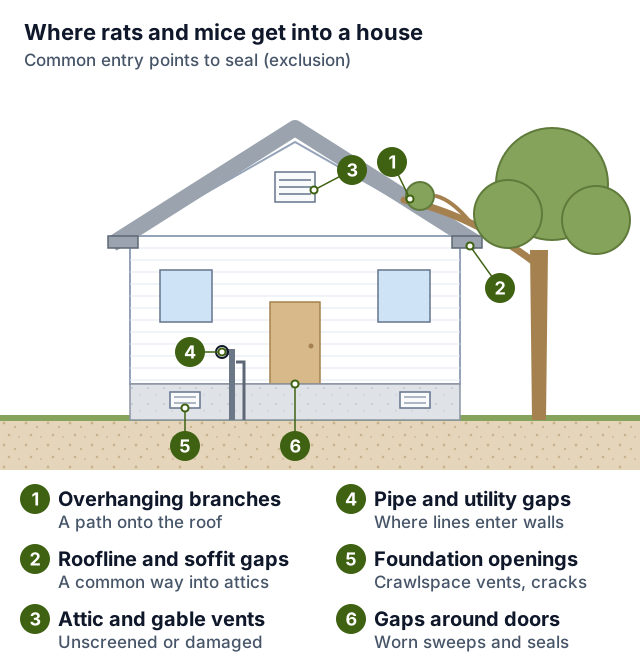
What Affects the Price
Providers quote their own work — these are the factors that consistently move the number.
- How many entry points need sealing, and how high or hard to reach they are
- Trapping alone vs. trapping plus exclusion and repairs
- How many follow-up visits and trap checks are included
- Attic and crawlspace access, the condition of the insulation, and the cleanup scope
- Whether the sealing work carries a warranty, and for how long
How It Works
- Step 1
Note what you've found
Droppings, gnawing, noises at night, and where you hear or see activity. Don't sweep or vacuum droppings.
- Step 2
We route your request
It goes to an independent local company that handles rats and mice in your area.
- Step 3
Check the license
Rats and mice fall under Household Pest Control (Category 29). Wildlife such as raccoons or bats needs a DNR wildlife license.
- Step 4
Compare what's included
Trap checks, entry points to be sealed, cleanup, follow-up visits and any warranty on the sealing work, in writing.
In an emergency?
Rodent Control & Exclusion FAQs
How much does a rat exterminator cost in Atlanta?
Angi's Atlanta data puts a rat trapping program at about $450–$1,140, compared with about $150–$650 nationally (Angi; HomeGuide). Exclusion work to seal entry points typically adds about $200–$1,500, depending on how many openings there are. See our rat and mouse exterminator cost guide for the breakdown.
What license does a rodent control company need in Georgia?
Rats and house mice fall under the structural Household Pest Control category (Category 29). That category covers commensal rodents and squirrels but not other mammals. Raccoons, opossums and bats need a Georgia DNR Nuisance Wildlife Control Operator license, and squirrel control may need both.
How do I safely clean up rat or mouse droppings?
Follow the CDC's steps: air the area out for 30 minutes, put on gloves, and don't sweep or vacuum. Spray the urine and droppings with one part bleach to nine parts water, let it soak for five minutes, then wipe it up with paper towels and throw them away.
Will traps alone solve a rodent problem?
Often not for long. Trapping removes the animals already inside, but if the gaps they used stay open, more can follow. Ask whether the quote includes an entry-point inspection and sealing, or only traps, so you're comparing the same job.
What about squirrels or raccoons in the attic?
Those are different jobs. Squirrel control may need both a Household Pest Control license and a Georgia DNR Nuisance Wildlife Control Operator license, and raccoons, opossums and bats need the DNR license. Ask the company which license it holds for the animal you have.
Local Rodent Control & Exclusion Guides
Rodent Control & Exclusion by Area
Need rodent control & exclusion?
Send the short form — no obligation.