Termite Bait vs Liquid Treatment: Which One Does Your Home Need?
A liquid termiticide barrier typically costs about $300 to $1,200 to treat a Georgia home, while a bait system typically costs $1,000 to $2,500 to install plus about $200 to $400 per year for monitoring (Fixr Georgia; HomeGuide). Both can protect a home from subterranean termites; the choice depends on your foundation, budget, and how you value upfront cost versus ongoing monitoring fees.
UGA Extension says subterranean termites, especially the eastern subterranean termite, are the main termite problem across the Southeast. In Georgia, termite swarms start in February and peak March through May. Whichever method you choose, the Georgia Structural Pest Control Commission rules require a written contract with a boxed statement saying whether the warranty covers retreatment only or retreatment and repair. That boxed statement matters more than the sales pitch.
At a glance
| Liquid barrier treatment | Termite bait system | |
|---|---|---|
| Installation cost | About $300–$1,200 for a Georgia home (Fixr); larger or harder homes can exceed $2,000 | About $1,000–$2,500 (HomeGuide); This Old House gives a wider $400–$3,000 |
| Per linear foot | About $3–$16 (Fixr Georgia $3.05–$16.15; HomeGuide $3–$20) | About $8–$12 nationally for installation (HomeGuide) |
| Ongoing cost | Annual inspection or renewal: about $150–$500/year (HomeGuide; Fixr Georgia $180–$420) | Annual monitoring or plan: about $200–$400/year (HomeGuide) |
| How it works | Termiticide applied to soil around and under the foundation; creates a treated zone termites cannot pass | Stations installed around the house; termites feed on bait and carry it back to the colony |
| Speed of protection | Immediate treated zone once application is complete | Protection depends on termites finding stations; may take months before monitoring shows activity |
| Georgia rules | Minimum treatment standards require debris removal, 6-inch trench, wood-to-soil clearance and label-rate application; deviations need an owner-signed Official Waiver | Contract must include a boxed warning that removing the system may leave the home unprotected; company must keep station-by-station monitoring records (Notice 24-01) |
| Best for | Immediate protection; homes with accessible perimeters; owners who prefer one-time treatment cost | Hard-to-access foundations; homeowners who prefer less drilling or trenching; ongoing monitoring |
What a liquid termite treatment involves
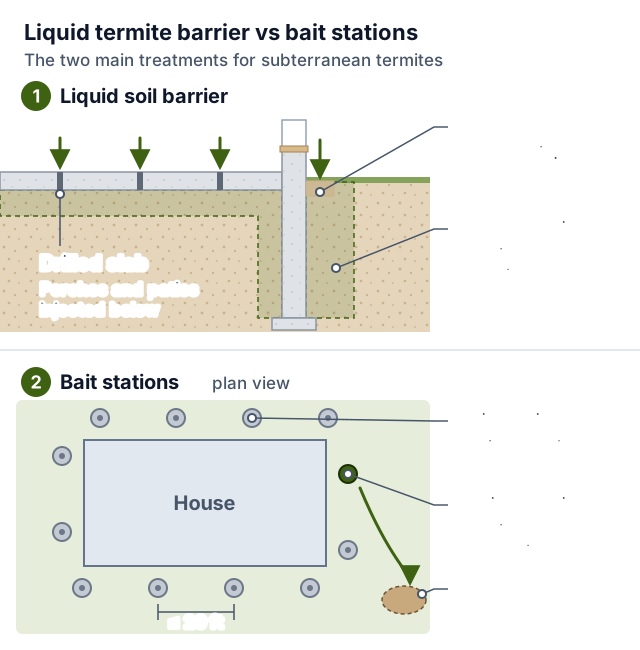
A liquid termiticide barrier is applied by trenching around the foundation and, where needed, drilling through slabs, porches and patios to inject termiticide into the soil underneath. The treatment creates a continuous zone of treated soil that termites cannot cross without picking up a lethal dose. Georgia's minimum soil-treatment standards require clearing debris, trenching to at least 6 inches and applying termiticide at the label rate. If a company cannot meet a minimum standard, it must record the deviation on an Official Waiver that the homeowner signs.
The upfront cost is typically about $300 to $1,200 for a Georgia home, per Fixr's Georgia-specific estimate, or about $3 to $16 per linear foot. Larger homes, slabs that need drilling and crawlspaces with poor access push the price up. Annual renewals or inspections typically run about $150 to $500 per year (HomeGuide; Fixr Georgia).
What a bait system involves
A termite bait system places monitoring stations in the soil around the home's perimeter. Mississippi State Extension notes that most manufacturers require stations no more than 20 feet apart, and closer spacing improves protection. Termites foraging in the soil encounter the stations, feed on the bait and carry it back to the colony. The key is monitoring: the company checks the stations on a schedule and replaces bait as needed. Protection depends on termites finding the stations, which can take months.
Installation typically costs about $1,000 to $2,500 (HomeGuide), with annual monitoring or a plan running about $200 to $400 per year. Georgia's Notice 24-01 on termite baiting requires the contract to include a boxed warning that removing the bait system may leave the home unprotected. The company must also keep station-by-station monitoring records and provide at least one year of monitoring at no extra charge for new-construction installations.
The Georgia termite contract (bond)
Whichever method you choose, Georgia rules require a written termite contract that states the treatment type, a diagram of the structure, the price, the term, and a boxed statement saying whether the warranty covers retreatment only or retreatment and repair. The contract must also show the renewal fee, how many years it is fixed and how often the company reinspects. You sign before work starts, and the contract must disclose your 3-day right to cancel.
If you are buying a home with an existing termite contract, ask whether the warranty transfers and at what fee. UGA Extension notes that many companies sell five-year contracts renewed annually, and suggests asking in writing for an annual inspection if one is not already included. The termite bond checker on this site walks through these contract terms.
How to decide
Ask the company why it recommends one method over the other for your specific foundation. Liquid treatments provide immediate protection and are often cheaper upfront but involve drilling and trenching. Bait systems involve less disturbance and suit hard-to-access foundations but rely on ongoing monitoring and may take longer to show results.
Compare the total cost over several years, not just the first-year price. A $1,500 bait installation plus $300 per year in monitoring comes to $2,700 over four years; a $1,000 liquid treatment plus $200 per year in bond renewals comes to $1,800 over the same period. Both numbers are estimates from published sources, not quotes, and your actual costs will depend on your home and the companies you contact.
Frequently Asked Questions
Is bait or liquid treatment cheaper for termites?
Liquid is usually cheaper upfront: about $300 to $1,200 versus $1,000 to $2,500 for a bait system (Fixr Georgia; HomeGuide). Over several years, the gap can narrow depending on renewal and monitoring fees. Compare the total cost, not just the first year.
Does Georgia require a specific treatment type?
No. Georgia allows both liquid barriers and bait systems. The rules set minimum standards for each: soil-treatment requirements for liquid and monitoring-record requirements for bait. The contract must state which method is being used.
Can I switch from bait to liquid or vice versa?
Yes, but talk to the company holding your current contract first. Georgia's bait rules require a boxed warning that removing the bait system may leave the home unprotected. Switching typically means a new contract and new first-year costs.
Which method works faster?
Liquid treatment creates a treated zone immediately once the application is complete. Bait systems depend on termites finding the stations, which can take months. If you have active termites and need fast results, ask the company about timing.
Should I get a second opinion?
For a treatment that may cost $1,000 or more and involve a multi-year contract, getting a second quote from a different WDO-licensed company is reasonable. Compare the method, the boxed warranty statement and the renewal fee before signing.
Information only — not legal or financial advice. Data last reviewed 2026-10-28.
Sources
- Fixr: Termite Treatment Cost in Georgia (Jan 31, 2025) (third-party estimate)
- HomeGuide: Termite Treatment Cost (Nov 21, 2025) (third-party estimate)
- This Old House: Termite Treatment Cost (Jun 17, 2026) (third-party estimate)
- UGA Extension B1241: Termite Control Services, Information for the Georgia Property Owner
- Rules of the Georgia Structural Pest Control Commission (effective April 8, 2026)
- Georgia Dept. of Agriculture: Notice 24-01, Termite Baiting
- Mississippi State University Extension: Termite Bait Stations (Bug's Eye View, Vol. 7, No. 10, 2021)
Need help figuring out next steps?
Send the short form — we'll route you to an independent local pro.