Wasp, Hornet & Yellowjacket Removal
Yellowjacket nests in the ground or walls, wasp nests under eaves, and hornet nests in trees, with the safety steps to take before a company arrives.
- Which Georgia license each job needs, and how to look it up
- Cost ranges cited to Angi, HomeGuide and Fixr, never invented
- Termite letter (WIIR) and termite bond rules in plain English
- Free to use, with no obligation and no markup
Fast response from independent local providers. No obligation.
Typical national cost$300 – $700Cost guide →About Wasp, Hornet & Yellowjacket Removal
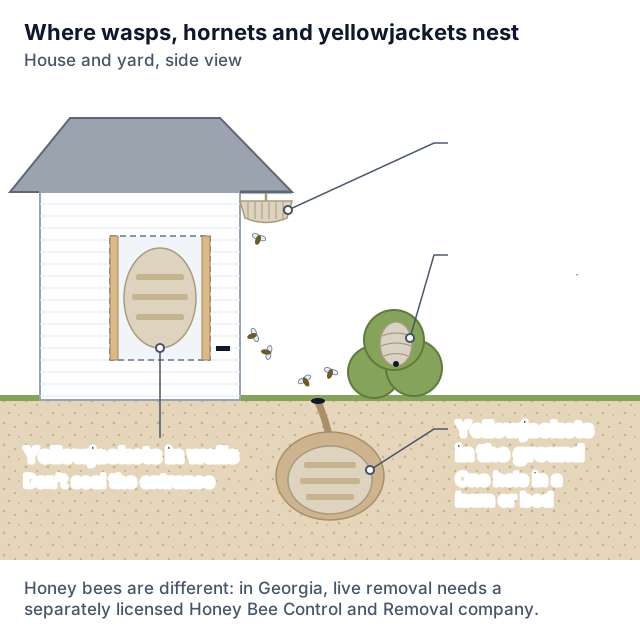
Yellowjackets are the stinging insect that sends most Atlanta homeowners looking for help. UGA Extension notes that wasp and yellowjacket populations peak in fall, and that colonies can reach several hundred workers by September. Many nest underground in lawns and landscape beds, or inside wall voids and attics. Often the first sign is a sting while mowing, or a steady stream of insects flying in and out of a gap in the siding.
Two cautions before anything else. Don't seal the entrance of an active nest in a wall, attic or the ground; leave it for the company to deal with. And if someone who's been stung has trouble breathing, swelling of the face or throat, or feels faint, call 911.
Published figures put nest removal at about $300–$700 per nest (Angi; HomeGuide). Small, easy-to-reach nests can be around $100, and large or hard-to-reach nests can run up to about $1,300. HomeGuide lists yellowjacket nests separately at about $600–$1,200. Our wasp nest removal cost guide explains what moves the price.
In Georgia, wasps, hornets and yellowjackets fall under the structural Household Pest Control license (Category 29). Honey bees are different: live removal of honey bees needs a separate Georgia Honey Bee Control and Removal license, for both the operator and the company. If you aren't sure which insect you have, say so in your request. Atlanta Pest Guide routes requests to independent local companies, which quote and carry out the removal themselves.
Common Jobs We Route
- Yellowjacket nests in lawns, landscape beds and under shrubs
- Yellowjacket and wasp nests inside wall voids, soffits and attics
- Paper wasp nests under eaves, decks, porch ceilings and play sets
- Hornet nests in trees and shrubs
- Nests near doorways, pools and play areas that can't wait
- Working out whether it's honey bees, which need a separately licensed removal service
What Affects the Price
Providers quote their own work — these are the factors that consistently move the number.
- Nest location: ground and eave nests are simpler than wall voids, attics or nests high in trees
- Nest size and how established the colony is (fall colonies are the largest)
- Species: yellowjacket nests are often priced higher than paper wasp nests
- Number of nests treated in the same visit
- Follow-up visits, and any wall opening or repair needed to remove a nest from a void
How It Works
- Step 1
Keep people away
Mark the spot, keep kids and pets clear, and don't seal the nest entrance. Call 911 for severe allergic reactions.
- Step 2
We route your request
It goes to an independent local company that removes stinging-insect nests in your area.
- Step 3
Check the license
Wasps and yellowjackets fall under Household Pest Control (Category 29). Honey bees need the separate Honey Bee Control and Removal license.
- Step 4
Confirm the scope
Number of nests, any follow-up visit, and who handles opening or repairing a wall if a nest has to come out.
In an emergency?
Wasp, Hornet & Yellowjacket Removal FAQs
How much does yellowjacket nest removal cost?
Published figures put wasp, hornet and yellowjacket nest removal at about $300–$700 per nest (Angi; HomeGuide). HomeGuide lists yellowjacket nests separately at about $600–$1,200, and large or hard-to-reach nests can run up to about $1,300.
Why are yellowjackets so bad in the fall?
UGA Extension notes that wasp and yellowjacket populations peak in fall, when colonies can reach several hundred workers. Larger colonies mean more insects defending the nest, which is why late-season nests near lawns and doorways cause so many stings.
Can I just plug the hole where they're going in?
Don't seal an active nest's entrance, whether it's in a wall, an attic or the ground. Keep people and pets away from it and let the company deal with the nest.
What if it's honey bees, not wasps?
Live honey bee removal in Georgia needs a separate Honey Bee Control and Removal license, for the operator and the company. If you think you have honey bees, say so when you ask for help, and ask the company whether it holds that license.
What license does a wasp removal company need in Georgia?
Wasps, hornets and yellowjackets are insects covered by the structural Household Pest Control category (Category 29). Check the company on the Georgia Department of Agriculture's structural pest control license search.
Wasp, Hornet & Yellowjacket Removal by Area
Need wasp, hornet & yellowjacket removal?
Send the short form — no obligation.