Yellowjacket or Wasp Nest: What to Do Right Now
Yellowjackets streaming in and out of a hole in the lawn, a gap in siding or an attic vent usually means an active nest. UGA notes that wasp and yellowjacket populations peak in fall and that colonies can reach several hundred workers by September, which is why so many Atlanta-area nests get noticed late in the season.
The goal right now is to keep people and pets away from the entrance and avoid anything that stirs up the colony. If someone has a severe reaction to a sting, call 911 first and deal with the nest later.
If this is unsafe or getting worse right now, don't wait — send an emergency request and it's flagged for priority routing to an independent local pro.
What to do in the first 5 minutes
- If anyone stung has trouble breathing, swelling of the face or throat, or feels faint, call 911 now.
- Keep children and pets away from the entrance, and mark the spot so nobody mows, trims or walks over it.
- Note where the insects go in and out: a hole in the ground, a gap in siding or trim, a vent, or a nest hanging from an eave or tree.
- If the entrance leads into a wall or attic, leave it open and keep interior doors to that area closed.
- Look at the insects from a safe distance. Fuzzy bees working a comb are likely honey bees, which need a separately licensed remover in Georgia.
- For wasps, hornets or yellowjackets, contact a licensed structural pest control company (Household Pest Control, Category 29).
Do not do this
- A sting followed by trouble breathing, throat or face swelling, or dizziness is a medical emergency. Call 911.
- Don't seal or plug the entrance of an active nest inside a wall or attic. The insects may look for another way out, including into the living space.
- If you use an over-the-counter wasp or hornet spray, follow the label exactly. Using a pesticide in a way that isn't consistent with its label violates federal law (EPA).
- Don't spray or try to remove honey bees yourself. In Georgia, honey bee control and removal is a separately licensed service (Georgia Department of Agriculture).
Common causes
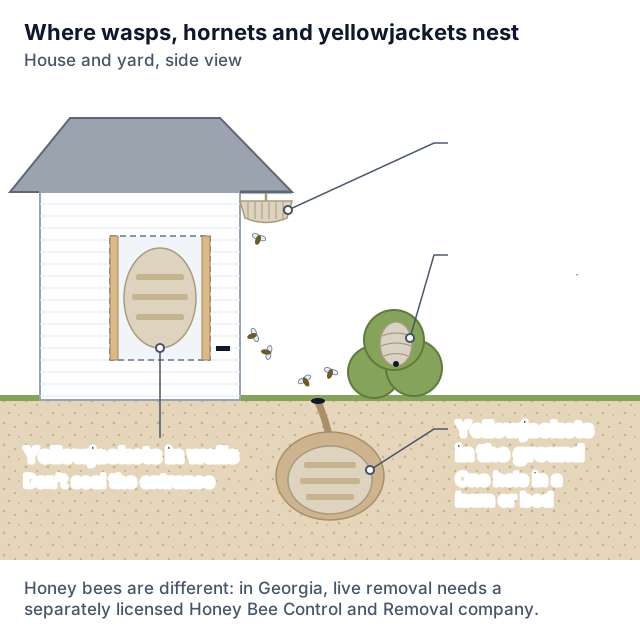
Ground-nesting yellowjackets (most common in lawns)
Yellowjackets often nest underground in soil cavities. Colonies build through the summer and reach several hundred workers by September (UGA), so ground nests are often found by mowers in late summer and fall.
A nest inside a wall void or attic
Yellowjackets and some hornets enter through gaps in siding, soffits, vents or around pipes and build inside the structure. These nests are harder to reach and typically cost more to remove.
Paper wasps or hornets on the outside of the house
Open, umbrella-shaped paper wasp nests under eaves and enclosed hornet nests in trees or shrubs are visible and usually easier to treat than hidden yellowjacket nests.
Honey bees (lookalike)
A honey bee swarm or colony in a wall can look like a wasp problem. Honey bees need a Georgia Honey Bee Control and Removal licensee, not a standard pest treatment.
What it typically costs
Nest removal typically costs about $300 to $700 per nest. HomeGuide lists yellowjacket nests separately at about $600 to $1,200, since they're aggressive and often hidden in the ground or walls. Small, easy nests can be about $100, and large or hard-to-reach nests can reach about $1,300.
Frequently Asked Questions
Is a yellowjacket nest an emergency?
The nest itself usually isn't, as long as people and pets stay away from it. A sting followed by trouble breathing, swelling of the face or throat, or dizziness is: call 911.
Can I just seal the hole in the wall?
Not while the nest is active. Sealing the entrance can push the insects to find another way out, including into your home. Leave it open and have a licensed company treat it.
When are yellowjackets worst in Georgia?
UGA notes wasp and yellowjacket populations peak in fall, with colonies reaching several hundred workers by September. Around Atlanta, searches for nest removal also rise in March–April and September–October.
Who removes honey bees in Georgia?
A company or operator licensed for Honey Bee Control and Removal by the Georgia Department of Agriculture. That's separate from the Household Pest Control license used for wasps and yellowjackets.
The service that handles this
Guidance only — independent local providers assess and price their own work. Last reviewed 2026-10.
Sources for the cost figures
- UGA CAES: Hornets, yellow jackets noticeable this time of year
- UGA CAES: As weather cools, prepare for fall insects
- Georgia Dept. of Agriculture: Honey Bee Control and Removal
- EPA: Introduction to Pesticide Labels
- HomeGuide: Wasp and Hornet Nest Removal Cost (third-party estimate)
Prefer to just talk to someone?
Send the short form — we'll route you to an independent local pro.