Rats or Mice in the House or Attic: What to Do Now
Scratching in the attic or walls at night, droppings in a cabinet, or gnawed food packaging usually means rats or mice have found a way in. Searches for rodent help around Atlanta tend to climb from October through February, the months when rodents typically move indoors.
The first priorities are protecting your family while you clean up and finding out how they're getting in. Droppings and nests need to be cleaned the way the CDC describes, not swept or vacuumed.
If this is unsafe or getting worse right now, don't wait — send an emergency request and it's flagged for priority routing to an independent local pro.
What to do in the first 5 minutes
- Put food, pet food and garbage in sealed containers so rodents have less to eat.
- Before cleaning droppings, urine or nesting material, open doors and windows and let the space air out for 30 minutes (CDC).
- Wear gloves while you clean (CDC).
- Don't sweep or vacuum droppings, urine or nests (CDC).
- Spray droppings, urine and nesting material with a mix of 1 part bleach to 9 parts water, let it soak for 5 minutes, then wipe it up with paper towels (CDC).
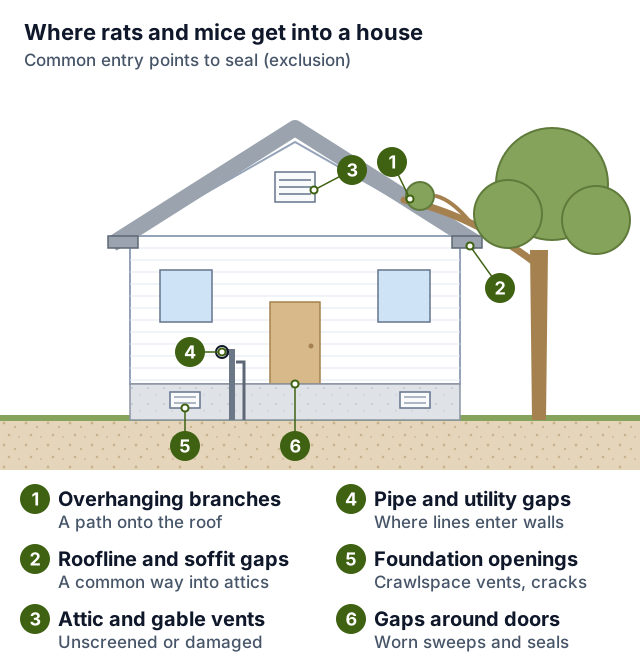
- Note where you see signs (attic, kitchen, garage, crawlspace) and any gaps around pipes, vents or the roofline, and ask a licensed company to inspect and seal entry points.
Do not do this
- Never sweep or vacuum rodent droppings, urine or nesting material. CDC's cleanup steps call for airing out the space for 30 minutes, wearing gloves, and soaking the material with a 1:9 bleach-to-water solution for 5 minutes before wiping it up with paper towels.
- If you use rodent baits or traps, follow the product label exactly and keep them away from children and pets. Using a pesticide in a way that isn't consistent with its label violates federal law (EPA).
- Rodent control for hire in Georgia falls under the Household Pest Control category (Category 29). Check a company on the Georgia Department of Agriculture's license search before you hire.
Common causes
Gaps around pipes, vents and utility lines
Small openings where plumbing, gas or cable lines enter the house, and unscreened vents, are common entry points. Sealing them (exclusion) is what keeps new rodents out.
Rooflines, soffits and attic vents
Noises overhead often mean rodents are getting in high, through roofline gaps, damaged soffits or vents, sometimes from overhanging branches.
Easy food and shelter
Open pet food, bird seed, garbage and cluttered storage areas give rodents a reason to stay once they're inside.
Cooler months
Search interest in rodent control around Atlanta runs highest from October through February, which lines up with rodents seeking shelter indoors.
What it typically costs
Rodent trapping programs typically cost about $450 to $1,140 in Atlanta according to Angi's Atlanta data, versus roughly $150 to $650 nationally. Inspections typically run $75 to $200, and sealing entry points (exclusion) about $200 to $1,500. See the rat exterminator cost guide for the breakdown.
Frequently Asked Questions
How do I safely clean up mouse or rat droppings?
Follow CDC's steps: air out the space for 30 minutes, wear gloves, don't sweep or vacuum, spray the droppings and nesting material with 1 part bleach to 9 parts water, wait 5 minutes, then wipe up with paper towels.
Why do I hear rats in the attic at night?
Rats and mice are mostly active at night, and attics give them shelter. Noise overhead usually means an entry point high on the house, such as a roofline gap, soffit or vent. An inspection should find it.
Is trapping enough to get rid of rats?
Usually not on its own. Trapping removes the rodents inside; exclusion seals the gaps so new ones can't get in. Ask for both in the quote.
What license does a rodent control company need in Georgia?
A structural pest control company license with a certified operator in Household Pest Control (Category 29), which covers commensal rodents such as rats and house mice. Check it on the Georgia Department of Agriculture's license search.
The service that handles this
Guidance only — independent local providers assess and price their own work. Last reviewed 2026-10.
Sources for the cost figures
- CDC: How to Clean Up After Rodents
- EPA: Introduction to Pesticide Labels
- Georgia Dept. of Agriculture: Structural Pest Control license search
- Angi: How Much Does a Rat Exterminator Cost in Atlanta, GA? (Aug 4, 2026) (third-party estimate)
- HomeGuide: Rodent Removal Cost (Sep 2, 2025) (third-party estimate)
Prefer to just talk to someone?
Send the short form — we'll route you to an independent local pro.