Commercial Pest Control
Documented, scheduled pest control for Atlanta restaurants, apartment communities, offices, warehouses and other businesses.
- Which Georgia license each job needs, and how to look it up
- Cost ranges cited to Angi, HomeGuide and Fixr, never invented
- Termite letter (WIIR) and termite bond rules in plain English
- Free to use, with no obligation and no markup
Fast response from independent local providers. No obligation.
About Commercial Pest Control
Restaurants, food warehouses, apartment communities, offices, schools, clinics and shops across metro Atlanta need pest control that's documented, scheduled and consistent. Commercial service usually means more frequent visits than a home plan, monitoring devices for rodents and insects, written service reports, and recommendations on sanitation and building fixes that the business is expected to act on.
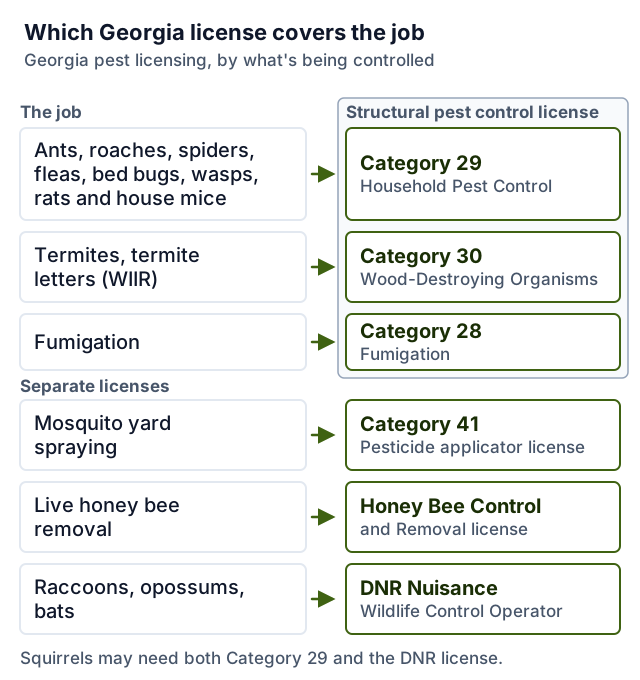
Georgia licenses commercial pest work by what's being controlled. Household pests and rodents fall under Category 29 (Household Pest Control), termites and other wood-destroying organisms under Category 30 (WDO), and fumigation under Category 28. Mosquito spraying on a property is separate again: Category 41, under the pesticide applicator program. Ask which categories the company's operators hold for the scope you're buying, and look the company up on the Georgia Department of Agriculture's license search.
Every service visit in Georgia must leave a record naming the pesticide, its EPA registration number, the target pest, the areas treated and the technician. For a business, those records belong in one place. They're what you may be asked for by a health inspector, a landlord, an insurer or a franchise auditor, and they're the evidence you'd need if you ever had to ask the Georgia Department of Agriculture to investigate a problem.
No publisher reports reliable commercial pest control prices for Atlanta, because commercial contracts are priced site by site. Atlanta Pest Guide routes commercial requests to independent local companies, which survey the property and quote their own programs.
Common Jobs We Route
- Restaurants, commercial kitchens and food service
- Apartment communities and multifamily buildings, including unit turnovers
- Offices, retail stores and medical offices
- Warehouses, food storage and distribution facilities
- Termite inspection and treatment for commercial buildings
- Property management portfolios that need consistent service across sites
What Affects the Price
Providers quote their own work — these are the factors that consistently move the number.
- Facility size, layout and number of buildings or units
- Visit frequency, and whether call-backs between visits are included
- Pests covered, and the number of monitoring stations or devices
- Reporting and documentation requirements set by your industry, landlord or auditors
- Scheduling outside business hours to avoid disrupting customers or residents
How It Works
- Step 1
Describe the property
Type of business, size, pests you're seeing, and any inspection or audit requirements you have to meet.
- Step 2
We route your request
It goes to an independent local company that offers commercial service in your area.
- Step 3
Match license to scope
Household pests and rodents are Category 29; termites are Category 30. Confirm the company's categories on the GDA lookup.
- Step 4
Set the reporting terms
Visit schedule, service records, who receives reports, and how call-backs between visits are handled.
Commercial Pest Control FAQs
What license does a commercial pest control company need in Georgia?
The same structural pest control company license as residential work, with a certified operator in each category the job requires: Category 29 for household pests and rodents, Category 30 for termites and other wood-destroying organisms, and Category 28 for fumigation. Mosquito spraying needs a Category 41 pesticide applicator credential.
What records should a commercial pest control company provide?
At minimum, Georgia requires a record of every service visit naming the pesticide, its EPA registration number, the target pest, the areas treated and the technician. Many businesses also ask for monitoring-device logs, trend reports and written sanitation or repair recommendations. Agree on these before signing.
How often should a restaurant have pest control?
There's no single answer. Commercial food-service contracts usually involve more frequent visits than a home plan, and your health inspector, landlord, franchise standards or insurer may set expectations. Ask the company to explain the frequency it recommends and what's included between visits.
Can one company cover multiple properties?
Many companies serve property portfolios across metro Atlanta. Ask how service is tracked across sites, who your contact is for each property, and whether reports are consistent from one location to the next.
Commercial Pest Control by Area
Need commercial pest control?
Send the short form — no obligation.