Found Bed Bugs? What to Do Right Now
Finding a bed bug, or rusty spots and shed skins along mattress seams, is upsetting, but it isn't a medical emergency. The CDC says bed bugs aren't known to spread disease, and bites can take up to 14 days to appear, so new bites don't always mean a new problem.
Bed bugs are hard to get rid of on your own, and the CDC recommends an experienced professional. What you do in the next few days can keep them from spreading to other rooms and make treatment simpler.
If this is unsafe or getting worse right now, don't wait — send an emergency request and it's flagged for priority routing to an independent local pro.
What to do in the first 5 minutes
- Confirm what you found: capture a bug on clear tape or in a sealed bag, and photograph spots along mattress seams, the box spring and the headboard.
- Keep sleeping in the same room. Moving to a couch or another bedroom can carry bed bugs with you.
- Bag bedding and clothing from the affected room in sealed plastic bags before taking them to the laundry.
- After travel, keep luggage off the bed and out of bedrooms, and unpack directly into the laundry.
- Don't throw out furniture yet; ask the company that inspects whether it can be treated.
- Contact a licensed structural pest control company and ask how it will confirm the bed bugs are gone.
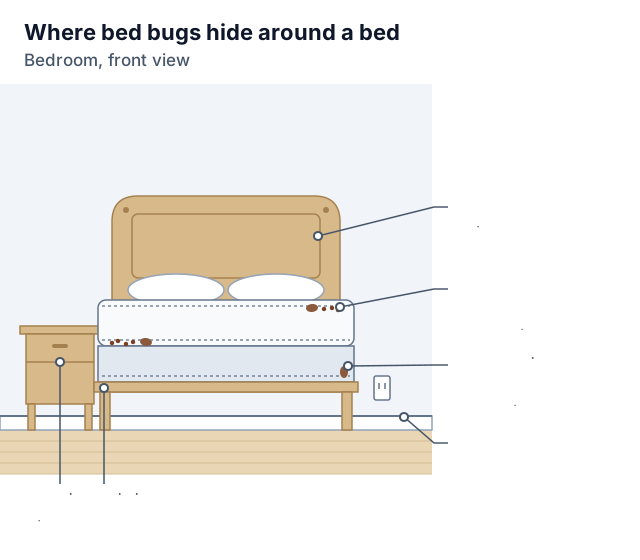
Do not do this
- Never use outdoor pesticide products indoors (EPA).
- Only use products with an EPA registration number on the label, and follow the label exactly. Using a pesticide in a way that isn't consistent with its label violates federal law (EPA).
- EPA recommends integrated pest management: combining inspection, cleaning, non-chemical methods and targeted treatment rather than relying on a single product.
Common causes
Travel
Bed bugs hitch rides in luggage and clothing from hotels and other places people sleep, then move into your bedroom.
Secondhand furniture and mattresses
Used beds, upholstered furniture and items left on the curb can carry bed bugs hidden in seams and joints.
Shared walls
In apartments, condos and townhomes, bed bugs can move between units, so a neighbor's problem can become yours.
Visitors and shared belongings
Guests, borrowed items and bags brought home from dorms or shelters can introduce them too.
What it typically costs
Professional treatment typically costs about $100 to $500 per room for heat, or about $1 to $3 per square foot to heat a whole home (roughly $1,000 to $6,000). Chemical treatment typically runs about $200 to $775 per room. These are national ranges; no publisher reports Atlanta-specific bed bug prices.
Frequently Asked Questions
Do bed bugs spread disease?
The CDC says bed bugs aren't known to spread disease. If bites are bothering you, talk to a doctor or pharmacist.
How long until bed bug bites show up?
Bites can take up to 14 days to appear, according to the CDC, so you may find bites days after the bugs arrived.
Can I get rid of bed bugs myself?
It's difficult, and the CDC recommends an experienced professional. If you use products, EPA says never use outdoor pesticides indoors, check for an EPA registration number and follow the label.
What license does a bed bug company need in Georgia?
Georgia's rules don't name bed bugs explicitly, but they fall within the Household Pest Control category (Category 29) as the rules define it. Check the company on the Georgia Department of Agriculture's license search.
The service that handles this
Guidance only — independent local providers assess and price their own work. Last reviewed 2026-10.
Sources for the cost figures
- CDC: About Bed Bugs
- EPA: Bed Bugs
- EPA: Safety Issues When Controlling Bed Bugs
- EPA: Introduction to Pesticide Labels
- Georgia Dept. of Agriculture: Structural Pest Control license search
- Fixr: Bed Bug Exterminator and Heat Treatment Cost (national) (third-party estimate)
Prefer to just talk to someone?
Send the short form — we'll route you to an independent local pro.